Sunday, September 29, 2019

Morro Bay Interlude

Morro Bay is gem of a CA State Marine Sanctuary just a half hour over the hill from us.


We loaned our home to our daughter and a passel of young women for a bachelorette party, so we had to suck up the inconvenience and find someplace to stay.  Gray's Inn on the bay wasn't too bad!


Here's a sunrise shot of Morro Rock, the bay's namesake. 


People come from far and near to play here.  Foreign languages intermingle with the rapping of rigging and the cries of gulls.  


Stand-up paddle boarding is a wonderful way of getting close to the wildlife.  I had brown and white pelicans gliding within 20 feet of me, was squawked at by great blue herons resting on moored boats, and enjoyed watching otters harvesting shellfish from hulls, then knocking them against each other to crack them and nibble away.  

A dock moored in the open has been commandeered by sea lions and seals, perhaps 50 wedged between and atop one another.  I've never gotten a good count because they're a big pile of blubber -- when one slides into the water, others just ooze into the vacated space.  This day I noticed a body partially in the water and couldn't tell if the tail was submerged, or maybe the head.  Eventually this seal pulled her head out of the water to take a breath, looked around languidly, and let it drop back under.  Awhile later, the same.  She waved her flippers around a bit, testing the possibility of nudging a neighbor over, gave up and let her head drop in again.  It just wasn't worth the trouble.  These guys are pretty relaxed!

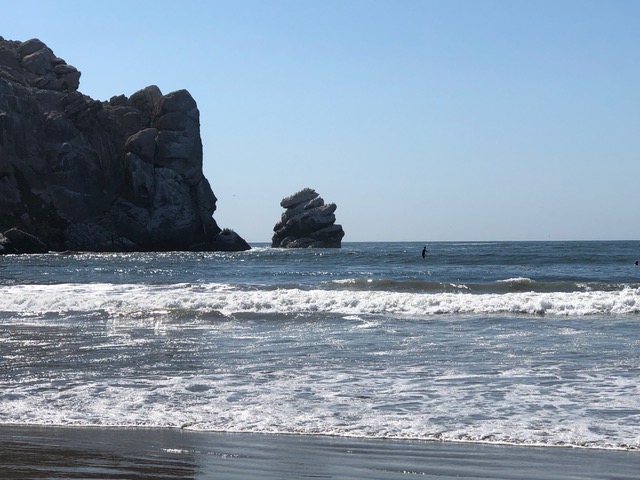
Paddlers, surfers and shorebirds play in the ocean waves north of the Rock.  


Not far east across the dunes are The Stacks.  
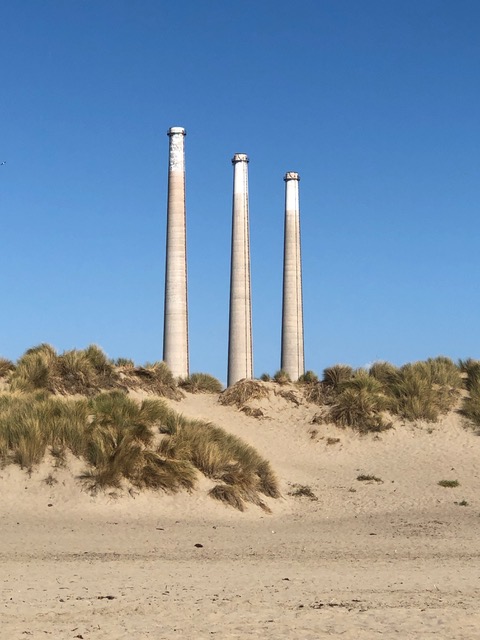
                 

The PG&E plant was decommissioned, but The Stacks live on in controversy. Many hate their ugly, industrial intrusion on the beautiful scenery, others who have seen them since, it seems, time immemorial, find them iconic.  Since my parents were reared not far south, these have been part of the view all my life, and I've found them in those old postcards with tinted photos.  So I'm on the iconic side, and I enjoy their juxtaposition with The Rock, each equally massive, one like a smooth, rigidly symmetrical modern sculpture, the other fully natural, textured, and geologically interesting.

Morro Rock is a volcanic plug or neck, one of many that formed near one another 25 million years ago.


This set of volcanos, sitting on the Pacific Plate, traveled north as the North American plate shifted south; they arrived at their present location, 300 miles northward, moving at the pace of a fingernail growing.  I'm afraid they haven't stopped moving!  But for now they make good climbing in San Luis Obispo County, excepting Morro, which is for the birds.  (The web explanations for how to maintain the clarity of photos I download to Blogger is, unfortunately, beyond my current understanding!)


The Rock entertains throughout each day as sun, wind and fog color its character.


Friday, September 6, 2019

Jackson Pollack's Fractals

I ran across the concept of the 'coastline paradox' (previous post) in an autobiography by Benoit Mandelbrot, or maybe in James Gleick's fun book Chaos: The Making of a Theory.  Wandering around in the land of fractals, there's no telling what you'll find.  It turns out Jackson Pollack's paintings are so full of fractal patterns that the experts can distinguish his from fakes 93% of the time by comparing these patterns.  Furthermore, Pollack's paintings have a similar effect on the brain's relaxation response to viewing fractals in art and in nature.  So I wonder if THAT is why his Greyed Rainbow hit me so powerfully when I walked into the modern wing of The Art Institute of Chicago.  
(My July 12th post mentions this experience.  And I wish these photos were in better focus, but Chicago is a bit far to go for a redo.)


Cognitive neuroscientists have come up with the concept of 'fractal fluency' to  discuss people's intuitive attraction to fractals.  The idea is that we've adapted to easy processing of fractal patterns due to our exposure to these in nature, and further that this 'fluency' puts the viewer in a 'comfort zone,' inducing a pleasant aesthetic experience.  


Now there's discussion of 'fractal expressionism' in art, with Pollack as the masthead.  Regardless, some friends have reacted to my art with "What is it?" and "Why?"  My response (which I wish I'd thought of in the moment) is that I'd like to elicit in the viewer a feeling similar to when you're hiking and suddenly come upon a field of wildflowers:  'Oh!  Ahhh!'  Maybe there's some underlying connection here between this hope of mine and the neuroscientists' reasoning about people's reactions to Pollack's paintings.  


But my response wasn't only about pattern.  I think the dynamism captured me in some sort of vicarious kinesthesia.  I could feel Pollack's movement, sense the freedom of his large gestures as he moved on foot around the canvas on his floor.  

So his paintings didn't just relax me, they inspired me!  They shifted something in me!  Once home I covered my studio floor with brown paper, bought a variety of paint store colors and some big, cheap canvases.  Then I went to town
in my Pollack phase...


...which eventually morphed into my own style.


Wednesday, August 21, 2019

Speaking of Small: Sand!


From the distance of a gallery wall, this photo inspired curious guesses about what it might be.  Many saw it as trees on a hilltop.


Near our home was an old shed built of eleven scavenged elevator doors.  I found this five-inch detail on one: thick enamel paint pealing off of rusting metal.  With the ease of digital editing, blowing up this small area to a larger scale enhances its luscious textures and colors.

Dr. Gary Greenberg descends much further down the size scale, using the remarkable microscope he invented (high-definition, three-dimensional light microscopes) to magnify beach sand (Gary Greenberg's Website).  He kindly gave me permission to include his photos here.  Looking REALLY closely, a scattering of grains from Maui reveals delightful treasures: bits of the earth -- volcanic and quartz, and biological bits -- tiny fragments of shells, coral, sponge spicules, sea urchin spines, coral and forams (July 11th post).


                            Greenberg

As he says, "When we walk along the beach we are strolling atop millions of years of biological and geological history...a record of an entire ecology."  His photographs represent the fascinating intersection of science and art.


                            Greenberg

The grains above (quartz, feldspar, garnet) are from the Great Sand Dunes that I photographed from afar in Colorado (August 14th post).  Again quoting Dr. Greenberg, "Each grain of sand represents a moment captured in time.  It is somewhere on its path from creation to erosion and recycling back into the earth."  Those tectonic forces I've mentioned, which rumpled up the Rockies, did so in part by subducting oceanic crust down into the furnace beneath the continent where gems like these melted ... re-formed ... were raised ... eroded ... and ... will repeat. 


                                        Sand Time - Greenberg


William Blake:  Auguries of Innocence

To see a world in a grain of sand
And a heaven in a wild flower,
Hold infinity in the palm of your hand,
And eternity in an hour.
.......


Tuesday, August 20, 2019

Speaking of Small: Sister Corita's Little Window

Figures from the world over came to Sister Corita for art classes during her prime in the '60's. Luckily she taught at Immaculate Heart College, just down the street from my parents' home.  My mom enjoyed her classes, and I tagged along a few times.  

You can see her work here:  Sister Corita images. Her images were so popular one was made into a postage stamp.


I recall in particular a lesson where we cut a small window in stiff paper to help us search for an appealing segment to blow-up into an abstract image:


Soon after we moved to New Mexico, I wanted to paint abstract paintings but had no clue how to begin -- I felt I needed help with composition.  I noticed that, as Sister Corita had taught, if I looked closely at small details in nature, I could scale up with my macro lens.  As it turned out, the photos themselves became my focus for several years -- nature offered wonders I could never paint.  Abstract painting would have to wait.


There were all sorts of old treasures lying around on the property when we moved.  The fun of macro photography is hearing people speculate about what they are seeing.  Several thought the photo above was a satellite image of a lake.  Actually it was an old metal bucket, rusting to pieces.  Its crumbling left an intriguing window into its dark interior.   


And sometimes nature supplies her own special window.


Friday, August 16, 2019

Granular Travel

Granular has entered the popular lexicon meaning lots of detail and specifics.  It seems apt for describing my preferred mode of travel, i.e., going slowly and looking closely at my surroundings.  On the other hand, I think of visiting national parks as a broad-stroke approach to getting to know the West.  

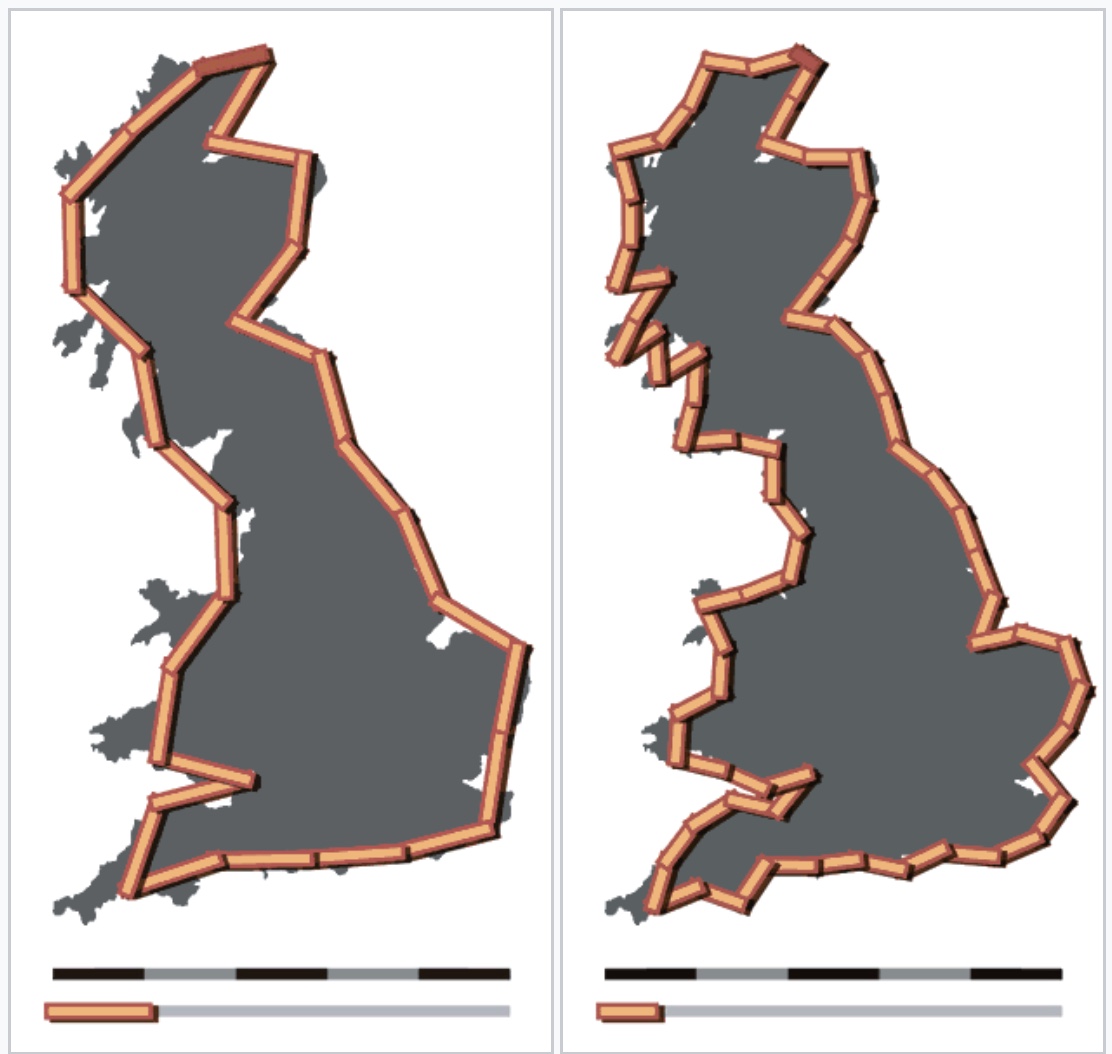
You can think of it as a matter of scale.  Just for fun, consider the 'coastline paradox.'  


If you measure the coast of Britain with a mile-long measuring stick, the result will differ vastly from the result with a ruler.  This is because as you look closer and closer, the amount of detail, and thus the length, move in the direction of infinity.  Compare the view from an airplane to what you see when strolling along a beach that wiggles in and out of coves and gulches and rock falls.  It's a question of measurement scale. 

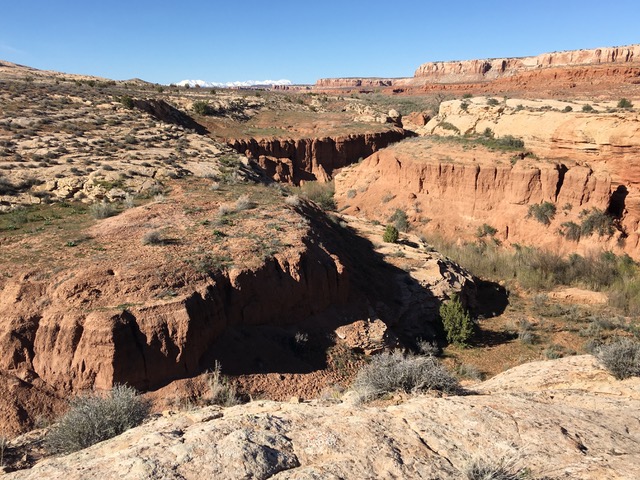
I like setting up my Ram and Capri camper in a spot with few people and settling in for several days, giving myself time to explore the area thoroughly.  (The second photo below is a detail of the first.)  I enjoy noticing, for instance, that the erosion patterns in soft mudstone right in front of me resemble those on the sides of mesas and mountains far distant.  I also get a kick out of imagining these small formations as cliff dwellings.  I sat there that afternoon speculating that the background harder sandstone this clung to had, in an earlier era, been entirely filled with mud, and these were the last remnants, soon to melt away entirely.  Areas get filled and emptied, filled and emptied.  Geologic processes offer a deeper a sense of time. 


There are delights in taking time to contemplate the grains in sandstone...


...the subtle detail in the corroding paint of old rusting cars...


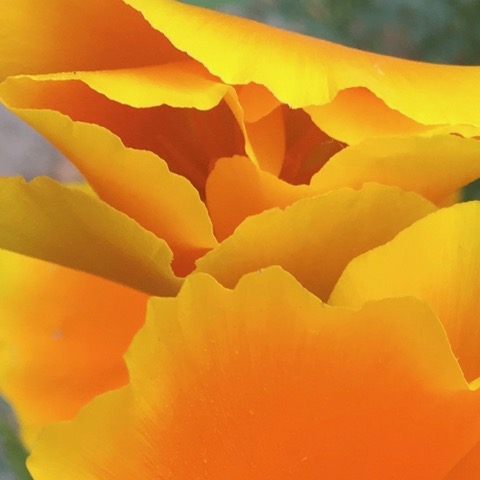
...the secrets hidden in a flower's center...


...and to look closely enough to spy two tiny blossoms having a sweet flirtation.


After a few days, moving on to another spot perhaps only a mile away, can offer an entirely new range of delights and discoveries.  As John Burroughs (the 19th century naturalist) said, "To learn something new, take the path that you took yesterday."


Wednesday, August 14, 2019

Our Western Wonderland


Only in retrospect could I see the shape of my journey.  I traveled up the eastward side of the Rockies, across the Bighorn Basin, then a short way down the Rockies' west flank before heading homewards.  I never anticipated the incredible variety of terrain and geology our western lands would offer. 

(note:  This post grew too long! My point was to show the variability of the terrain in this relatively small area.  Just cruising through the photos will give you the gist.  In later posts I'll describe more of the how and why, in addition to this overview of where.) 


When I embarked with my Capri camper, I had only a vague notion of where I was headed.  I didn't want a specific itinerary, but there were four books that gave some shape to the trip.  John Steinbeck's Travels with Charley offered the notion of just going to see what's out there.  John Galvin's The Meadow, an all-time favorite, aimed me toward southeastern Wyoming, with Tie Siding as a focal town.  In the introduction to The Daily Coyote, Shreve Stockton's passion for the land around Ten Sleep, WY, attracted me like a magnet.  And in This House of Sky, Ivan Doig's descriptions of the old ranching life in southern Montana transported me in time and place.  Also, I heard about the big white water festival in Salida, CO, so that became an early destination.

I was delighted at every turn by our beauteous west, from high deserts to towering mountains.  The late spring rains ensured that green was the dominant color, even in Wyoming in July, and despite one night of snow.


Spring greens enhanced northwest New Mexico's dramatic effect, where colorful sandstones were originally  sand dunes, beaches, and mudflats from the time of the dinosaurs.  Though not uplifted by tectonics, like most of the Rockies, these smaller ranges represent the southern reaches of that vast mountain region:


Colorado's Great Sand Dunes are still very much alive.  Their sands, including the tallest dunes in North America, incessantly travel back and forth, east and west, as the prevailing winds switch between the uplifted Sangre de Cristo Range, to the east, and the volcanic San Juan Mountains to the west.  The sands originated as sediments in huge valley lakes; the lakes dried and the sands accumulated in a curve in the Sangre de Cristos:


Northwards I drove through Colorado's high valleys rimmed by those spectacular mountains that give the Rockies their name.  They were predominately uplifted during the Laramide Orogeny (a tectonic mountain building episode),  but along the way I learned they are actually wonderfully  complex in their origins:


The views from above Tie Siding, CO, gave me a sense of the high meadow that, in Galvin's lyrical account, enchanted its owners over several generations:


Wyoming's plains then enchanted me:  Space and stillness alive with birdsong: 


The Rockies are composed of many discrete ranges; among these are high valleys and vast plains.   Wyoming's plains are basins depressed as surrounding mountains rose, later to be filled with seas (whose tidal actions created a lilting lumpiness in some areas), and still later filled and flattened with eroded mountain sediments:


The Bighorn Mountains, an eastern spur of the Rockies, expose rocks that have endured since the Cambrian, half a billion years ago:


The Bighorn Basin lies to the west.  Even within its flat reaches, surprises are hidden up side roads like Alkali Flats Back Country Byway.  This is dinosaur country, where you can walk beside tracks over 160 million years old: 


And beneath the horizon Devil's Kitchen is a very big and very gnarly hole in the ground, surrounded by lush ranch lands:


While the Bighorns consist of basement metamorphic rock, limestone, and what's left of eroded sedimentary layers, driving out of the basin into the Absaroka Range is altogether different.  It's actually a volcanic field that has weathered into fantastical spires and hoodoos:


The drive through this range into Yellowstone National Park is as beautiful as it gets.  Yellowstone has the mixed blessing of sitting top the hotspot that has led to at least three tremendous explosions of volcanic materials, which form the Abasarokas.  The geysers and colorful, steaming pools lie atop this devastation, hinting at future possibilities.


Southwards lie the Grand Tetons' spectacular peaks.  After uplift, the Tetons were sculpted by glaciers.  Their grandeur is indescribable...and impossible to capture on 'film':


Across a valley of farmland and marshes, Logan, Utah, sits at the base of the Wasatch Range on the western edge of the Rockies: 


From there I headed west and homeward, but not without a final, wonderful surprise on a lonely back road in northeast Utah: